How Kansas Baseball Became College Baseball’s Unlikeliest Powerhouse — And What the Roster Data Really Shows
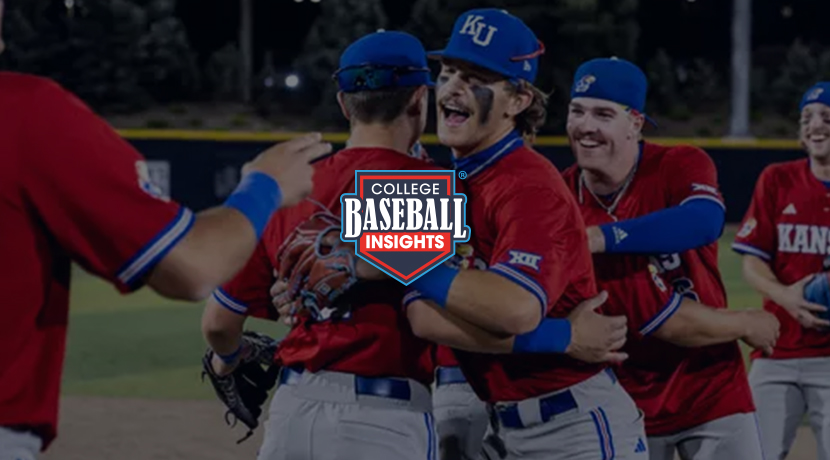
The ESPN article reflects the active roster at a point during the season after in-season attrition. CBI records all 37 players rostered at the start of the year and never removes them — giving families a complete picture of who was recruited into the program, including players who left mid-season. Similarly, ESPN’s figure of 23 players “directly from JUCO” only counts a player’s most recent prior school. Several additional players entered via the 4-year portal having previously come through the JUCO system in an earlier recruiting class — invisible in a straight JUCO count, but very much part of the pipeline.
If you’re the parent of a college baseball prospect, you’ve probably heard the name Kansas coming up more and more. The Jayhawks just won the Big 12 regular-season title — their first conference championship since 1949 — and ESPN ran a major feature explaining how they did it: by building an entire roster around junior college transfers when no one else was.
At College Baseball Insights, we’ve been tracking Kansas’s roster movement for four years. Here’s what the data shows — and why it matters for families evaluating programs right now.
The story ESPN told
When Dan Fitzgerald arrived at Kansas in June 2022, the program was coming off a 4–20 conference season under Ritch Price. There weren’t enough players to hold a scrimmage. Within five months, Fitzgerald and associate head coach Pat Coyne had assembled the #1-ranked JUCO recruiting class in the country — the first of four consecutive years they’d earn that distinction.
The philosophy was simple and completely counter to how Power 4 programs typically operate: where most schools sign one or two junior college players a year as depth pieces, Kansas would build its entire competitive core around them. The reasoning: JUCO players are physically mature, have proven themselves in a competitive environment, and arrive hungry to make good on a second chance at a bigger stage.
Fitzgerald’s JUCO roots run deep. He started coaching at North Iowa Area Community College in 2003, went 249–73 as head coach at Des Moines Area CC, built his reputation at Dallas Baptist, and spent a year as LSU’s recruiting coordinator before Kansas. Coyne, meanwhile, had worked as a Texas JUCO assistant and brought an unmatched depth of knowledge of the two-year college landscape.
“All we do is get up and think about where we can find good players and how we coach them.”
— Dan Fitzgerald, Kansas head coach
The result: a 39–16 record in 2026, a 22–8 conference mark, and a Big 12 championship. Dick Howser Trophy semifinalist Tyson LeBlanc — recruited out of LSU Eunice — led the team with 19 home runs. Fitzgerald earned his second straight Big 12 Coach of the Year award.
The four-year trajectory
Here’s how the program’s win percentage has moved since Fitzgerald took over:
| Season | Overall | Conference | Win % | Note |
|---|---|---|---|---|
| 2023 (Year 1) | 25–32 | 8–16 | .439 | Roster overhaul year |
| 2024 | 31–23 | 15–15 | .574 | Depth-building year |
| 2025 | 43–17 | 20–10 | .717 | Breakout / NCAA Tournament |
| 2026 🏆 | 39–16 | 22–8 | .709 | Big 12 Champions |
Three years from a roster rebuild to a conference title. That’s not an accident — it’s what a disciplined, repeatable recruiting system looks like when it reaches full operating tempo.
What CBI’s data shows that ESPN couldn’t
The ESPN story is told from the outside looking in. CBI tracks roster movement from the inside — every player added, every player who left, and why. Here’s what four years of data reveals.
Player churn: the engine of the pipeline
Kansas has operated at 70%+ roster turnover in three of the four seasons under Fitzgerald. That sounds alarming. For a JUCO-first program, it’s the model working exactly as designed.
| Season | Roster size | Players out | Players in | Attrition rate |
|---|---|---|---|---|
| 2026 🏆 | 37 | 29 | 27 | 74.36% |
| 2025 | 39 | 31 | 27 | 72.09% |
| 2024 | 43 | 14 | 21 | 38.89% |
| 2023 | 36 | 32 | 25 | 74.42% |
The 2024 season stands out as a deliberate outlier — Fitzgerald stabilized the roster after the massive 2023 overhaul, added more players than he lost (+7 net), and built the depth that would carry Kansas to a 43–17 record in 2025. The high-churn years on either side of it aren’t instability. They’re the pipeline cycling at full speed.
What this means for families: A 70%+ attrition rate at a traditional program is a red flag. At Kansas, it’s the mechanism. JUCO players typically arrive as JRs or R-SOs with two years of eligibility, contribute immediately, and move on — making room for the next class. If your son is considering Kansas, the question isn’t whether there’s roster churn. There is. The question is whether the next class is already assembled. CBI tracks that too.
The full transfer picture: 29 players, three pathways
The ESPN article states that 23 of 34 players came from JUCO. That’s accurate for the mid-season roster, counting most-recent prior school only. CBI’s full transfer data on the 37-player season-start roster tells a richer story:
| Player | Transfer from | Division | Position | Class |
|---|---|---|---|---|
| Carter Fink 4yr portal | East Tennessee State | NCAA-D1 | RHP | GR |
| Riane Ritter 4yr portal | St. Thomas (MN) | NCAA-D1 | RHP | SO |
| Toby Scheidt 4yr portal | Bryant | NCAA-D1 | RHP | SR |
| Landen Lozier 4yr portal | Minnesota | NCAA-D1 | IF | R-SO |
| Jordan Bach 4yr portal | SIU-Carbondale | NCAA-D1 | OF | GR |
| Josh Dykhoff 4yr portal | Minnesota-Crookston | NCAA-D2 | 1B | SR |
| Maddox Burkitt | Johnson County | NJCAA-D1 | RHP | R-JR |
| Kannon Carr | Jefferson (MO) | NJCAA-D1 | RHP | SR |
| Aiden Cline | Midland College | NJCAA-D1 | RHP | SO |
| Mason Cook | McLennan | NJCAA-D1 | RHP | SO |
| Dane Ebel | Lincoln Trail | NJCAA-D1 | RHP | JR |
| Darius Henderson | Salt Lake | NJCAA-D1 | RHP | SO |
| Daniel Lopez | Odessa | NJCAA-D1 | RHP | SO |
| Mathis Nayral | Cochise College | NJCAA-D1 | RHP | JR |
| Dalton Smith | Kansas City Kansas | NJCAA-D1 | RHP | SR |
| Manning West | Walters State | NJCAA-D1 | RHP | R-JR |
| Caleb Deer | Kansas City Kansas | NJCAA-D1 | LHP | JR |
| Augusto Mungarrieta | Northwest Florida State | NJCAA-D1 | C | JR |
| Gavyn Schlotterback | Paris | NJCAA-D1 | C | SO |
| Max Soliz | Chattahoochee Valley | NJCAA-D1 | C | SR |
| Cade Baldridge | Cowley | NJCAA-D1 | IF | JR |
| Brady Ballinger | Southern Nevada | NJCAA-D1 | IF | JR |
| Tyson LeBlanc | LSU-Eunice | NJCAA-D1 | IF | JR |
| Dylan Schlotterback | Paris | NJCAA-D1 | IF | R-SO |
| Savion Flowers | Cisco | NJCAA-D1 | OF | SO |
| Tyson Owens | Cochise College | NJCAA-D1 | OF | SO |
| Boede Rahe | Kirkwood | NJCAA-D2 | RHP | R-JR |
| Ty Thomson | Des Moines Area | NJCAA-D2 | LHP | JR |
| Dariel Osoria | Western Oklahoma State | NJCAA-D2 | IF | SR |
Players highlighted in blue entered via the 4-year transfer portal. Their most recent school is an NCAA institution, but some carry prior JUCO history from an earlier recruiting class — making them invisible in a “direct from JUCO” count.
Where the 37 players came from
The Kansas recruiting footprint is national, not regional — but it has a clear geographic spine:
| State | Players | Note |
|---|---|---|
| Texas | 6 | Deep JUCO system, strong Coyne relationships |
| Kansas | 5 | In-state anchor including Johnson County CC |
| Illinois | 3 | Lincoln Trail, Midwest JUCO corridor |
| Minnesota | 3 | Includes 4yr portal (St. Thomas, Minnesota) |
| Missouri | 3 | Jefferson MO, Kansas City Kansas CC |
| Iowa | 2 | Kirkwood CC connection (Boede Rahe) |
| Nevada | 2 | College of Southern Nevada (Brady Ballinger) |
| Georgia | 2 | Chattahoochee Valley CC |
| Michigan, Ohio, New York, NC, Alabama, Louisiana, Oklahoma | 1 each | Mix of JUCO and 4yr portal |
| Canada / Other | 3 | International reach |
The Midwest JUCO corridor — Iowa, Illinois, Minnesota, Missouri — forms a contiguous recruiting band right around Lawrence. Texas and Kansas dominate as the top two states. This is a national pipeline with a regional core, and CBI tracks every school in it.
Roster composition by position
Of the 37 players rostered at the start of 2026, pitching dominates — as expected for a JUCO-built program where arm development is a primary pipeline strength:
| Position | Count | % of roster | Primary class |
|---|---|---|---|
| RHP | 19 | 51% | R-SO, JR, SR, R-JR |
| IF | 6 | 16% | JR, R-SO |
| C | 5 | 14% | JR, SO, SR |
| LHP | 3 | 8% | JR |
| OF | 3 | 8% | SO, GR |
| 1B | 1 | 3% | SR |
What this means if your son is being recruited by Kansas
Kansas is a genuine D1 program with a championship-level staff, a proven development model, and a Big 12 conference schedule. Here’s what families should understand before committing:
- Roster churn is real and expected. 70%+ turnover every year is how this program operates. That’s not a flaw — it’s the design. Your son needs to understand he’s entering a competitive environment where playing time is earned and the next class is already being assembled.
- The pipeline rewards mature, proven players. Kansas almost exclusively recruits JUCO players and older 4yr transfers. If your son is a high school prospect, Kansas is unlikely to be the fit right now — but a JUCO stop that puts him on Fitzgerald’s radar could be.
- The 4-year portal is part of the model too. Six of 29 transfers on the 2026 roster came through the 4-year portal. Players like Carter Fink (East Tennessee State), Jordan Bach (SIU-Carbondale), and Landen Lozier (Minnesota) show that Kansas will also take experienced portal players who fit the roster need — even if their last stop wasn’t a JUCO.
- Playing time opportunity is real. A 19-person pitching staff and a 6-man infield means competition. But the 2026 roster had JR-class players contributing across every position group, and the class structure means opportunities open up every year.
- The coaching staff is stable. Dan Fitzgerald has been in place since 2022 and just won a conference title. Pat Coyne is a known quantity in the JUCO world. Staff stability matters enormously in a transfer-heavy program — it’s the constant that makes the pipeline work.
📊 This analysis was built using College Baseball Insights data
CBI tracks full season-start rosters — not just mid-season snapshots — across every D1 program. We record every transfer in and out, by position, class, and origin school, and we never delete players from the record. That’s how we can show you 37 players when ESPN sees 34, and how we can identify JUCO-origin players who entered through the 4-year portal. This is the kind of program intelligence families need before committing to a school — not after.
The bottom line
Kansas didn’t stumble into a Big 12 title. Fitzgerald and Coyne built a system — one that identified a market inefficiency in JUCO talent, built a national recruiting network to exploit it, and ran four consecutive classes through it until the wins followed.
The ESPN story told you what happened. The CBI data tells you how it was built — player by player, class by class, year by year. That’s the difference between reading about a program and actually understanding it.
Source: ESPN — “How the Kansas Jayhawks became college baseball’s unlikeliest powerhouse,” May 20, 2026. Roster, transfer, churn, and geographic data via College Baseball Insights.