Adopted · June 23, 2026
Age-Based Eligibility Model is now official
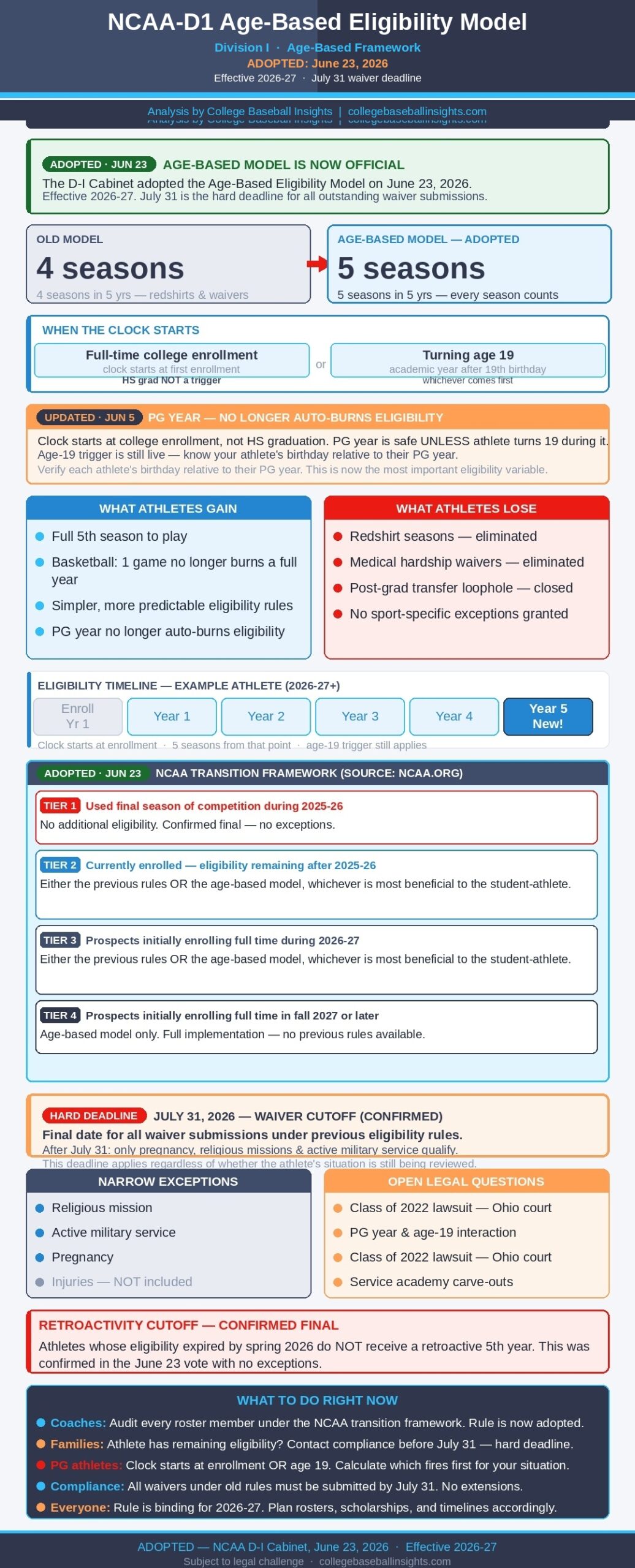
The D-I Cabinet voted June 23, 2026 to adopt the Age-Based Eligibility Model. It is binding for the 2026–27 academic year. The July 31 waiver deadline is confirmed and hard — no extensions.
Hard Deadline
July 31, 2026 — Final Waiver Cutoff
All waivers under previous NCAA eligibility rules must be submitted to the national office by July 31, 2026. After that date, only pregnancy, official religious missions, and active-duty military service qualify. No extensions will be granted.
Correction Notice: An earlier version of this content described a 5-tier transition framework. The official NCAA adoption announcement (ncaa.org, June 23, 2026) uses a 4-row framework. All content has been updated to reflect official NCAA language.
The NCAA Division I Cabinet officially adopted the Age-Based Eligibility Model on June 23, 2026. This FAQ is fully updated to reflect the final adopted rule. All content below is current as of the June 23 vote.
Q:What was decided on June 23, 2026?
A:The NCAA Division I Cabinet unanimously adopted the age-based eligibility rule on June 23, 2026. The five-year eligibility period begins with the earlier of: (1) initial full-time enrollment at any college or university including JUCOs, or (2) the start of the academic year immediately after the athlete’s 19th birthday if they turn 19 before September 1. The rule replaces season-of-competition counting, redshirts, and most waivers with one continuous five-year period that runs without pause.
Q:How does the clock start under the adopted rule?
A:The clock starts at the earlier of: (1) initial full-time enrollment at any college including JUCOs; (2) the age-19 trigger — the academic year after turning 19 if birthday is before September 1; or (3) competing for a college team even without full-time enrollment. High school graduation is not a trigger. Dual enrollment alone does not start the clock. Source: NCAA Eligibility 101, ncaa.org.
Full-time college enrollment
Clock starts at first enrollment
HS grad NOT a trigger
Turning age 19
Academic year after 19th birthday
Confirmed — unchanged
Whichever occurs first starts the five-year window · Confirmed in June 23 vote
Q:Does this apply to all NCAA divisions?
A:No — Division I only. D-II and D-III remain on their existing eligibility frameworks.
Q:My son is a 2026 HS graduate enrolling in college this fall. How does this affect him?
A:He falls under the 2026–27 transition year (Tier 3 of the official NCAA transition framework). His school will apply whichever model — the previous 4-in-5 rules or the new age-based rule — is most beneficial to him individually. Five seasons is not guaranteed automatically for this group. His school’s compliance office determines which model applies based on his birthday, enrollment date, and prior competition history. Contact compliance before making any assumptions.
Q:What about players doing a PG year at Choate or an academy like P27?
A:A PG year does not automatically start the eligibility clock. The NCAA Eligibility 101 page confirms dual enrollment during a PG year does not start the period by itself. However, two things DO start the clock during a PG year: (1) competing for a college team, even without full-time enrollment — explicitly stated in the official NCAA rule; and (2) the age-19 trigger if the athlete turns 19 before September 1 prior to college enrollment. Families must confirm their PG-year athlete is not competing for any college team.
PG Year — Confirmed Final:
A PG year no longer automatically costs eligibility. But the age-19 trigger is still live. If your athlete turns 19 during the PG year, the clock starts regardless of enrollment status. Know the birthday.
Q:Does dual enrollment in high school start the eligibility clock? NCAA Confirmed
A:No — the NCAA Eligibility 101 page states explicitly that dual enrollment in high school and college does not start the five-year period of eligibility by itself. However, if the student-athlete competes for a college team while dual-enrolled — even without full-time enrollment — that does start the clock. Families with dual-enrolled athletes must confirm their student is not competing for any college team.
Q:My son turns 19 on or after September 1. Does that change when his clock starts? NCAA Clarification
A:Yes — confirmed directly in the NCAA Eligibility 101 page. If an athlete turns 19 before September 1, the clock starts that same fall academic year. If they turn 19 on or after September 1, the clock starts the following academic year — unless they enroll full time in college earlier. This September 1 cutoff is one of the most consequential details in the rule and must be verified for every athlete.
Q:What if my athlete gets hurt and misses an entire season?
A:Medical hardship waivers are fully eliminated. The clock runs continuously and does not pause because an athlete does not compete. An injury year counts against the clock — no exceptions. The only exceptions that can pause the eligibility period are: active-duty military service, official religious missions, and pregnancy — and only if the athlete does not compete during that period. If an athlete competes at all during an exception period, the exception does not apply. Source: NCAA Eligibility 101.
Q:My son is finishing his degree this spring. Does he get a 5th year?
A:Only if he has eligibility remaining entering 2026–27. Athletes whose four seasons were exhausted by spring 2026 do not receive a retroactive fifth year. Confirmed final — no exceptions in the June 23 vote.
Source: NCAA.org — Division I adopts age-based eligibility model (June 23, 2026)
Tier 1Used final season of competition during 2025-26
No additional eligibility. Confirmed final — no exceptions.
Tier 2Currently enrolled — eligibility remaining after 2025-26
Either the previous rules OR the age-based model, whichever is most beneficial to the student-athlete.
Tier 3Prospects initially enrolling full time during 2026-27
Either the previous rules OR the age-based model, whichever is most beneficial to the student-athlete.
Tier 4Prospects initially enrolling full time in fall 2027 or later
Age-based model only. Full implementation — no previous rules available.
Age-based model only. Clock starts at first college enrollment. No flexibility.
Q:How does roster management change?
A:Redshirt rules are fully eliminated. The NCAA confirms the five-year period runs continuously — it does not pause because an athlete does not compete, transfers, sits out, changes teams, or takes time away from participation. Coaches no longer need to track athletic redshirts. Every roster plan must be built around individual enrollment dates and birthdays, calculated case by case. Source: NCAA Eligibility 101.