The Growing Influence of the JUCO Pipeline

The Growing Influence of the JUCO Pipeline
Every level of college baseball is more competitive than ever. With the transfer portal booming and rosters full of older, experienced college returners, players looking for 4-year opportunities out of high school are feeling the squeeze in a big way. Junior college (“JUCO”) programs, long a hotbed for development, competition, and moving players to the next level, have become even more of a proving ground for players hoping to play at 4-year schools or beyond.
Just how impacted are college rosters? How is that affecting high school players looking for opportunities? To what extent are JUCOs becoming a more common path to a 4-year roster? This piece was originally inspired by a conversation with our friends at KeepPlayingBaseball.org (“KPB”), and we’ve since taken ownership of the underlying analysis, expanding it into our own ongoing research initiative. Using nine full seasons of pipeline data, 2018 through 2026, we add context and data to the trends we see playing out in recruitment and leave you with a plan for how to use roster research to find a program that aligns with your goals and can help you make it to the next level.
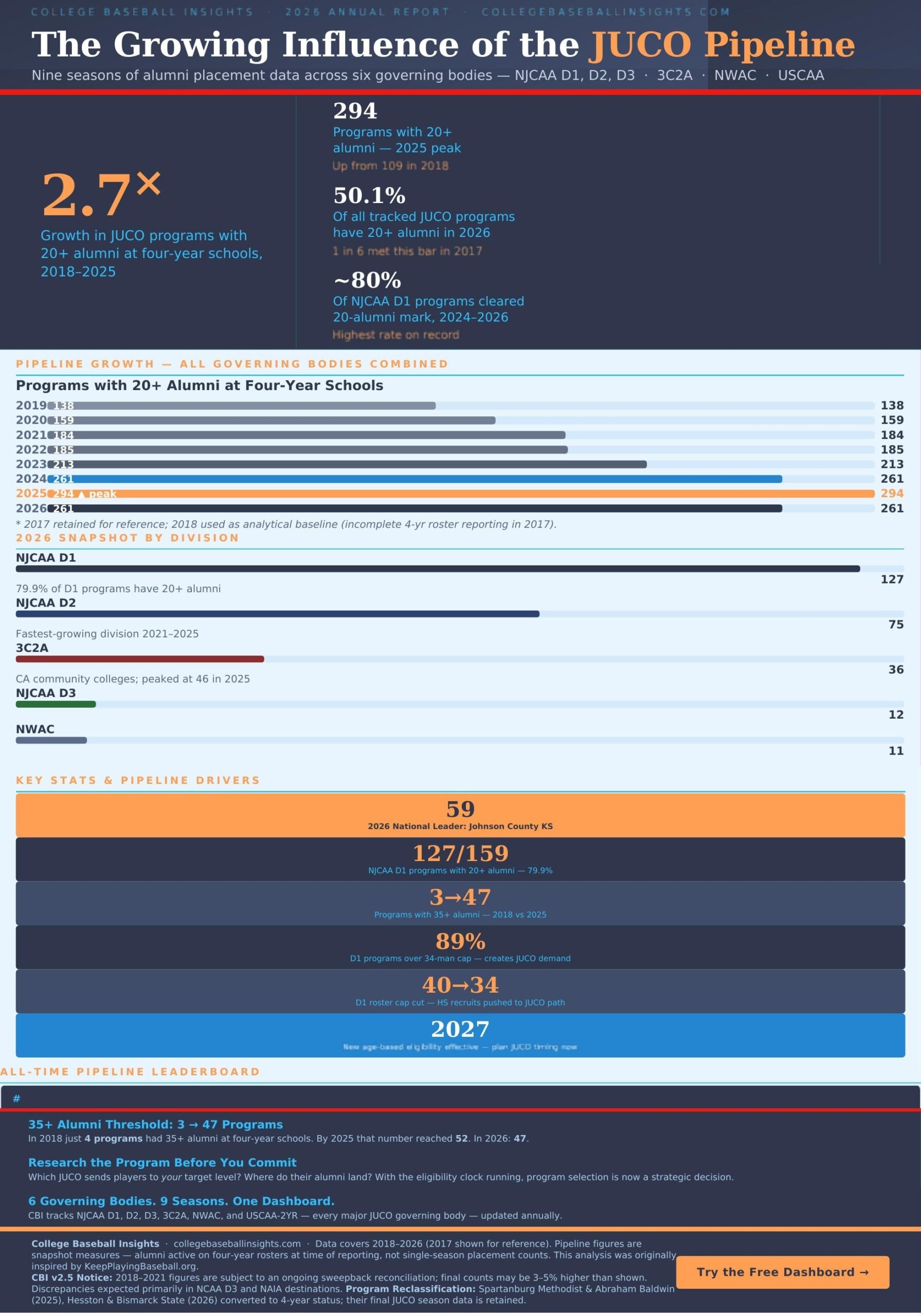
JUCO Pipeline at a Glance: 2026 Annual Summary ·
Source: College Baseball Insights / CBI Pipeline Dashboards
Building a Recruiting Class
Before we really dive in, an overview of general recruiting philosophies is helpful. 4-year programs generally recruit on need. Under normal circumstances, a roster with older players may take their chances with a heavier high school recruiting class, knowing these players will have time to develop and transition to college behind experienced guys. If a program needs impact players now, they typically reach into the transfer portal or JUCO ranks to get players with a track record of success against college competition. If a new coach has come in and cleaned house, they’ll likely use JUCO and the portal. This philosophy applies to positional needs as much as it does the overall composition of a recruiting class. Some programs are notorious for recruiting preferences that lean more heavily in favor of high school or JUCO recruits (which is something you can and should look up!), but the balance for most programs changes from year to year based on need—or at least it used to.
Recruiting with Impacted Rosters and Eligibility Waivers
COVID eligibility waivers, changes to the transfer rules, and a reduction in MLB draft rounds created a massive surplus of college players—many of whom were in college for 3+ years but still had 2-4 years of eligibility left. With a huge surplus of college-tested players on campus and in a position to transfer (portal and JUCO), college coaches at 4-year programs no longer needed to jeopardize their jobs and livelihood by taking the risk of recruiting large numbers of unproven high school players. This shift in strategy created a difficult challenge for many high school players who under pre-COVID circumstances would have been getting offers to play at 4-year programs. For several years following the pandemic, these high school prospects lost opportunities and roster spots to players already in college (transfers or just added eligibility years for players already on campus). As we’ll see below, our data suggests this isn’t a temporary blip—it’s a structural shift that has continued to build through the 2026 season.
The Trickle-Down Effect of Impacted Rosters and Recruiting Changes
With rosters full, high school players who typically compete for D1 roster spots are being pushed towards other opportunities (lots of D2 or JUCO). This in turn pushes the lower end of the typical D2 recruits towards JUCO and other opportunities. Making matters worse, players who have made it to 4-year campuses in recent years who typically would be playing by now are on the bench behind guys with extended eligibility or being asked to transfer. Coaches are having to make difficult roster/recruiting decisions. This means more transferring and more players filtering down to levels where they typically don’t end up, causing a roster crunch and less recruitment opportunity at all levels. The end result is our first message: college baseball, which was already competitive and strong at every level, is stronger and more competitive than ever. No level reflects this more than the JUCO route, because of the ease of transferring, the ability to live at home, and the affordability of school, among other reasons.
A Growing JUCO Pipeline: Numbers Behind the Trend
Always competitive and a great option for landing 4-year opportunities, just how much has the JUCO system changed in recent years? Our team at College Baseball Insights tracks alumni placement across every major JUCO governing body—NJCAA Division 1, NJCAA Division 2, NJCAA Division 3, 3C2A, NWAC, and USCAA—covering 2018 through 2026, and the numbers behind the trend are staggering.
2018: Where Our Tracking Begins
Our reliable tracking begins in 2018, when Wabash Valley (IL) and Parkland (IL) tied for the most alumni playing at 4-year schools of any JUCO program in the country, with 37 former players each on 4-year rosters. Cisco was close behind at 36. Across every JUCO level combined, only 4 programs nationwide had 35 or more alumni playing at 4-year schools, and just 109 programs (22.5% of all 485 tracked programs) had cleared the 20-alumni mark. (We do have 2017 data as well, but reporting on 4-year rosters that far back wasn’t complete enough to reliably identify transfers, so we use 2018 as our baseline year throughout this analysis.) The JUCO-to-4-year pipeline existed, but it was a narrow one.
2022 and 2023: The Inflection Point
By 2022, Iowa Western and Wabash Valley were tied atop the national leaderboard with 54 alumni each playing at 4-year programs—more than double what the national leader had posted just five years earlier. Twenty-four programs across all NJCAA D1 and D2 levels alone had 35 or more alumni at 4-year schools that season.
In 2023, Iowa Western pulled away with 65 alumni at 4-year programs—the single highest mark recorded anywhere in our dataset—with Wabash Valley second at 56. Nationally, 213 programs (42.0% of all programs tracked) had 20 or more alumni at 4-year schools that season, up from just 185 the year before and 109 back in 2018. Below, we examine the full historical trend of the JUCO pipeline to 4-year programs, which has continued to grow with no signs of slowing.
2024 to 2026: The Pipeline Keeps Widening
The growth didn’t stop in 2023. By 2025, 294 programs nationwide (57.1% of all tracked programs) had 20 or more alumni playing at 4-year schools—nearly 2.7 times the 109 programs that cleared that bar back in 2018. NJCAA D1 alone saw 86.4% of its 154 programs clear the 20-alumni threshold in 2025, the highest share recorded in our dataset. The 2026 season saw a modest pullback to 261 programs (50.1%), with Johnson County (KS) taking over the national lead at 59 alumni, followed by Cisco and Iowa Western tied at 51.
Programs with 20+ alumni at 4-year schools, 2018 vs. the 2025 peak — a 2.7x increase across all six governing bodies tracked.
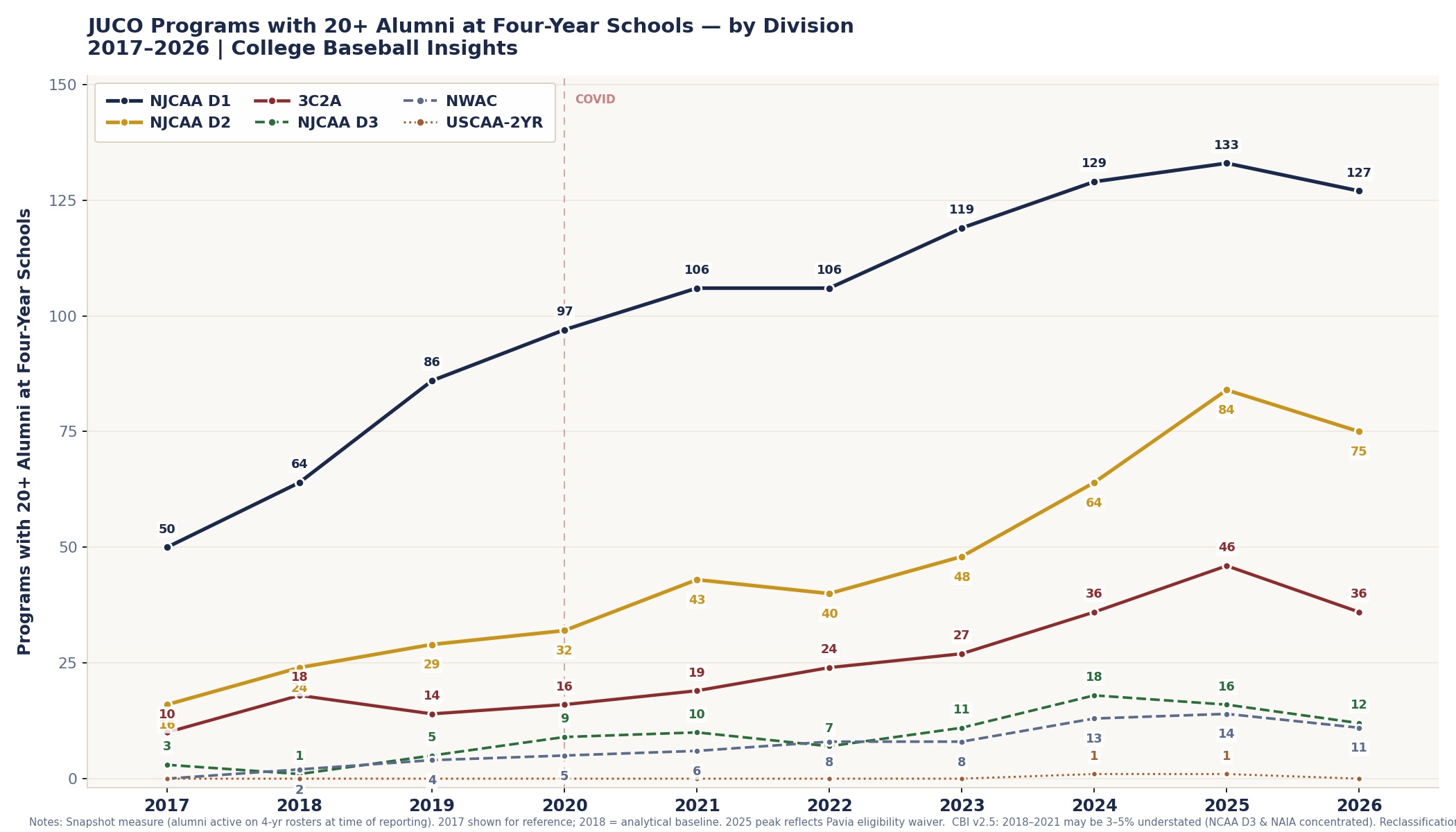
Programs with 20+ alumni at four-year schools by governing body, 2017–2026 ·
Source: College Baseball Insights / CBI Pipeline Dashboards
Historical Trends, 2018–2026
Extended eligibility is certainly a factor in the number of JUCO alumni playing at 4-year schools. Players are staying around longer, so more of them are representing JUCO programs at the 4-year ranks. As we move further away from the seasons directly impacted by COVID, we better understand which of these trends are here to stay for the long haul. If anything, the pandemic magnified what we already knew—the robust success of JUCO baseball as a proving ground for players and a pipeline to 4-year program success is growing, and that won’t be changing anytime soon. It’s also not just a few JUCOs in each state that are inflating the numbers. A rising tide of talent at the JUCO level has lifted the success of programs across every governing body we track, from the largest NJCAA D1 programs down to smaller conferences like 3C2A and NWAC.
The table below shows the number of JUCO programs, across all six governing bodies we track, with 20 or more alumni at 4-year programs in each season since 2018, which we use as our baseline because earlier 4-year roster reporting wasn’t reliable enough to confidently identify transfers. (We’ve included 2017 for reference, but treat it as directional rather than a clean comparison point.)
| Season | Programs with 20+ Alumni | % of All Tracked Programs |
|---|---|---|
| 2017* | 79 | 16.6% |
| 2018 | 109 | 22.5% |
| 2019 | 138 | 28.0% |
| 2020 | 159 | 31.5% |
| 2021 | 184 | 36.9% |
| 2022 | 185 | 36.8% |
| 2023 | 213 | 42.0% |
| 2024 | 261 | 51.8% |
| 2025 | 294 | 57.1% |
| 2026 | 261 | 50.1% |
*2017 4-year roster reporting was incomplete and not reliable enough to confidently identify transfers; shown for reference only.
And here’s the same trend isolated to programs with 35 or more alumni at 4-year schools—a much higher bar that, in 2018, almost no program in the country could clear:
| Season | Programs with 35+ Alumni | National Leader |
|---|---|---|
| 2017* | 3 | Cisco (TX) — 40 |
| 2018 | 4 | Wabash Valley (IL) / Parkland (IL) (tied) — 37 |
| 2019 | 7 | Cisco (TX) — 38 |
| 2020 | 8 | Monroe College (NY) — 43 |
| 2021 | 19 | Wabash Valley (IL) — 48 |
| 2022 | 24 | Iowa Western / Wabash Valley (tied) — 54 |
| 2023 | 28 | Iowa Western (IA) — 65 |
| 2024 | 41 | Iowa Western (IA) — 62 |
| 2025 | 52 | Johnson County (KS) / Iowa Western (tied) — 55 |
| 2026 | 47 | Johnson County (KS) — 59 |
*2017 shown for reference only; see baseline note above.
When you crunch the numbers, the growing trend of the JUCO pipeline is clear. JUCO baseball in general, and certain programs specifically, have carved out a reputation for getting players to the level they want to go. With our data, you can easily see who these programs are and where they are sending their players to play at the next level.
See the Full JUCO Pipeline Data for Yourself
Explore program-by-program alumni placement across all six governing bodies — NJCAA D1, D2, D3, 3C2A, NWAC, and USCAA — free on our interactive dashboard.
Same Game, Same Rules: What the New NCAA Eligibility Model Means for JUCO Players
On June 23, 2026, the NCAA unanimously approved a new age-based eligibility model — the most significant rules change in decades, driven in large part by the NJCAA’s longstanding “Same Game, Same Rules” campaign and the wave of lawsuits sparked by Vanderbilt quarterback Diego Pavia. Effective 2027-28, student-athletes will receive five full seasons of competition, with the clock starting at the earlier of full-time enrollment or the academic year after they turn 19.
For the JUCO pipeline, the implications are real but nuanced. The blanket eligibility waiver the NCAA granted for 2025-26 as a result of the Pavia litigation inflated the pipeline snapshot numbers in that season — contributing to the peak of 294 programs with 20+ alumni. The 2026 pullback to 261 programs is partly explained by that waiver expiring, not by any weakening in JUCO placement rates. The underlying pipeline remains strong.
The age-based model does not fully resolve the NJCAA’s core argument — JUCO seasons can still burn eligibility depending on timing. Families and coaches need to understand the age trigger and plan accordingly. The programs that place players most consistently to your target level are more valuable than ever when your eligibility window is finite.
Four Questions Every Family Must Ask Before Choosing a JUCO Program
Pipeline numbers tell you which JUCO programs have historically placed players at four-year schools. They don’t tell you whether those conditions still exist today. Before committing to a program, every student-athlete and family should be asking four questions that JUCO program websites almost never answer.
1. Who Is the Head Coach — and How Long Have They Been There?
JUCO coaching turnover is among the highest in all of college baseball. A program’s historical pipeline numbers may reflect a coach who left two years ago, taking their recruiting network and four-year relationships with them. The current coach may be new, still building connections, and operating with a fundamentally different placement track record. At College Baseball Insights, we track every head coaching change across the JUCO landscape and publish an annual Head Coaching Carousel covering all known changes entering each season. Coaching tenure is the single most overlooked variable in JUCO program research.
2. How Large Is the Roster — Really?
A 45-man JUCO roster and a 28-man JUCO roster are not the same opportunity. Roster size directly determines how much playing time, at-bats, and innings a player will realistically see. Our internal roster reconciliation process — which tags incoming transfer students, corrects graduation class data, and tracks outbound placements — gives us one of the most accurate pictures available of true program roster size year over year. JUCO program websites rarely publish this information in a usable form. Check the numbers before you sign.
3. Does the Program Have a Development Team?
Some JUCO programs operate a development or JV squad that keeps younger or developing players active and getting repetitions while the varsity roster competes. For a player who needs consistent reps to improve, a program with a development team is a meaningfully different environment than one without. This is one of the harder data points to track — it depends entirely on whether programs self-publish development team information — but it is worth a direct question to the coaching staff before committing. When programs do publish this information, we flag it in our data.
4. Does the Program Redshirt Players?
JUCO players have two years of eligibility. A program that routinely redshirts freshmen is effectively offering a one-year placement window rather than two. This is rarely disclosed upfront and almost never appears on program websites. Through our roster reconciliation process, we can often infer redshirt patterns from the gap between players who appear on rosters and players who show up in outbound transfer counts the following season. Ask the coach directly: “Do you redshirt players, and under what circumstances?” The answer will tell you a great deal about the program’s philosophy.
The hard truth is that JUCO program websites are among the least complete in all of college athletics. Schedules, rosters, and coaching staff information are frequently out of date, incomplete, or simply absent. That information gap is exactly why roster research — using tools that go beyond what programs publish themselves — is not optional. It is the foundation of a sound decision.
Key Takeaways and Action Items for Recruits
First, players who scoff at JUCO opportunities need to re-evaluate their beliefs. It’s a legitimate path to 4-year programs and increasingly the best chance to stick at 4-year programs. Across the board, JUCOs are having success: as of the 2026 season, 261 JUCO programs across all six governing bodies we track have 20 or more alumni playing at 4-year programs right now—and nearly 80% of NJCAA D1 programs alone have cleared that mark in each of the last three seasons.
The second major takeaway is the incredible value of doing roster research to learn about programs and guide questions during the recruiting process. There simply is no substitute for quality research on a program you are considering. Whether you comb through web pages on your own like our friends at KeepPlayingBaseball.org discuss here or use our data at College Baseball Insights to save you valuable time and simplify the process, roster research is a must.
How many players at your position do they have? How often do those players transfer out? Do they come from your area? What does player overall attrition look like? Are they getting a lot of D1 bounce-backs? Does the JUCO you are considering succeed at getting players to 4-year programs? How does it compare to other JUCO programs in your area? Are they going to the level and schools where you ultimately want to end up?
With our resources, you can answer these questions quickly, saving you time with research and time pursuing schools that likely won’t recruit you or are not a fit. The information also gives insight into questions you should ask coaches directly during recruitment (EX: It looked like 5 freshmen from last year’s team didn’t return. What is the main reason players are leaving?). We’ll address these types of questions at length in a future article.
Finally, no matter what level you plan to play in college, you need to be informed when you show up and have a plan. What are your goals? What type of program will provide the environment you are looking for? Answering these questions and developing a plan starts with learning as much as possible about the program you are considering. There’s no need to wait! This process is cheap (it can be free if you do the work yourself) and easy. Get started today, we’re here to help!
Ready to Research Your Next Program?
The JUCO Pipeline Dashboard puts nine seasons of alumni placement data at your fingertips — filter by division, conference, or school to find the programs that place players where you want to go.
Data Reconciliation Notice (CBI v2.5): CBI version 2.5 introduced enhancements to the player transfer reconciliation process. Prior to this release, some transfers may have been missing from historical records. An ongoing sweepback project is reconciling data for 2018–2021; once complete, figures for those seasons may be 3–5% higher than currently shown. Discrepancies are expected to be concentrated in the NCAA D3 and NAIA destination categories, as these divisions historically have the highest rate of missing previous-school data in transfer records. 2022 and later seasons reflect the improved reconciliation methodology.
Program Reclassification Notice: A small number of JUCO programs converted to four-year institution status during the tracking period and may appear in pipeline data up through their final JUCO season. Known conversions include: Spartanburg Methodist College and Abraham Baldwin Agricultural College (reclassified prior to the 2025 season), and Hesston College and Bismarck State College (reclassified prior to the 2026 season). Alumni counts for these programs in their final tracked seasons should be interpreted accordingly.
Note on Roster Data: Rosters are always changing and data is constantly updated and reconciled. Even though the trends are clear, these exact numbers are subject to slight changes as more information is evaluated. We use 2018 as our analytical baseline throughout this piece, since 2017 4-year roster reporting wasn’t complete enough to reliably identify transfers; 2017 figures are included in the tables above for reference only. This analysis was originally inspired by our friends at KeepPlayingBaseball.org, and we at College Baseball Insights have since taken ownership of the underlying research. Data covers all reported seasons 2018–2026 and was last reconciled July 8, 2026.